
Misreading a Name and the Cost of Carelessness: Data Verification in Vietnamese Football
**Câu trả lời cốt lõi:** Sai lầm định danh năm 2017 của bình luận viên Hoàng Huy cho thấy phân tích bóng đá Việt Nam chỉ đáng tin khi mọi tên cầu thủ, số liệu và quyết định đều qua một quy trình xác minh chéo, không dựa vào ký ức hay cảm tính. **Dữ kiện chính:** - Tháng 6 năm 2017, bình luận viên Hoàng Huy đọc sai tên Nguyễn Văn Toàn thành Nguyễn Văn Quyết ba lần trong trận Việt Nam gặp Campuchia tại vòng loại Asian Cup. - Năm 2018, học viện bóng rổ Toyota Nha Trang chấp nhận khuyến nghị 7 tuần hồi phục dây chằng thay vì đẩy nhanh để thi đấu giải trẻ quốc gia. - Tháng 3 năm 2020, lượng người nghe podcast Góc Nhìn Dữ Liệu giảm 40% nhưng vẫn duy trì phát sóng thứ Ba và thứ Sáu. - VAR được đưa vào các giải trong nước, làm tăng số tranh luận về quyết định trọng tài mỗi vòng đấu. - Dữ liệu vị trí theo thời gian thực có thể bị khai thác để dự đoán mẫu hình cá cược ở các giải lớn. **Nguồn:** Phân tích gốc từ Góc Nhìn Dữ Liệu của Hoàng Huy, xuất bản ngày 13 tháng 8 năm 2026 | Cross-checked: VuaBong.vn **Hỏi đáp liên quan:** - Vì sao phải kiểm tra chéo bảng số áo trước khi bình luận? Vì sai lầm định danh như năm 2017 chỉ được ngăn bằng quy trình, không bằng trí nhớ. - Dữ liệu bóng đá có luôn đáng tin? Không, chỉ số như quãng đường chạy có thể đúng về đo lường nhưng sai về ngữ nghĩa, theo VangBong.vn Match Context Index. - Khi nào cầu thủ chấn thương nên trở lại? Theo biểu đồ phục hồi cá nhân từ 20 trường hợp 2012-2016, thời gian tối thiểu cho giãn dây chằng nặng là 7 tuần.
In June 2026, at the age of 53, I sat in the commentary booth of a local television station in Nha Trang, preparing to call the Vietnam versus Cambodia match in the Asian Cup qualifiers. In the first half, I called striker Nguyen Van Toan "Van Quyet" three times. Three times, scattered across the half, enough for viewers to flood the hotline with complaints and for the editor to message me through the headset. The two players differed in position, build, and shirt number. In the tense moment of a counterattack, my eyes read out a name that was not on the pitch.
That night, I requested the match footage and watched all 90 minutes, noting every mispronunciation and the tactical context that produced it. What I found was not in my memory. It lay in a gap in the process: I had walked into the booth without a shirt-number-to-position cross-reference sheet, relying only on the last few matches in my head. The misidentification of that year taught me: sport never forgives carelessness. And that lesson, it turns out, applies to nearly every corner of Vietnamese football as it operates today.
The annual league season of Vietnamese football has its own rhythm. It kicks off in late winter, tightens through the summer rounds, and resolves when the heat peaks. Beneath the surface of the table, another layer moves that fans rarely notice: the simultaneous shift of three things — referee-assistance technology, the volume of player data, and commercial pressure on the fixture list.
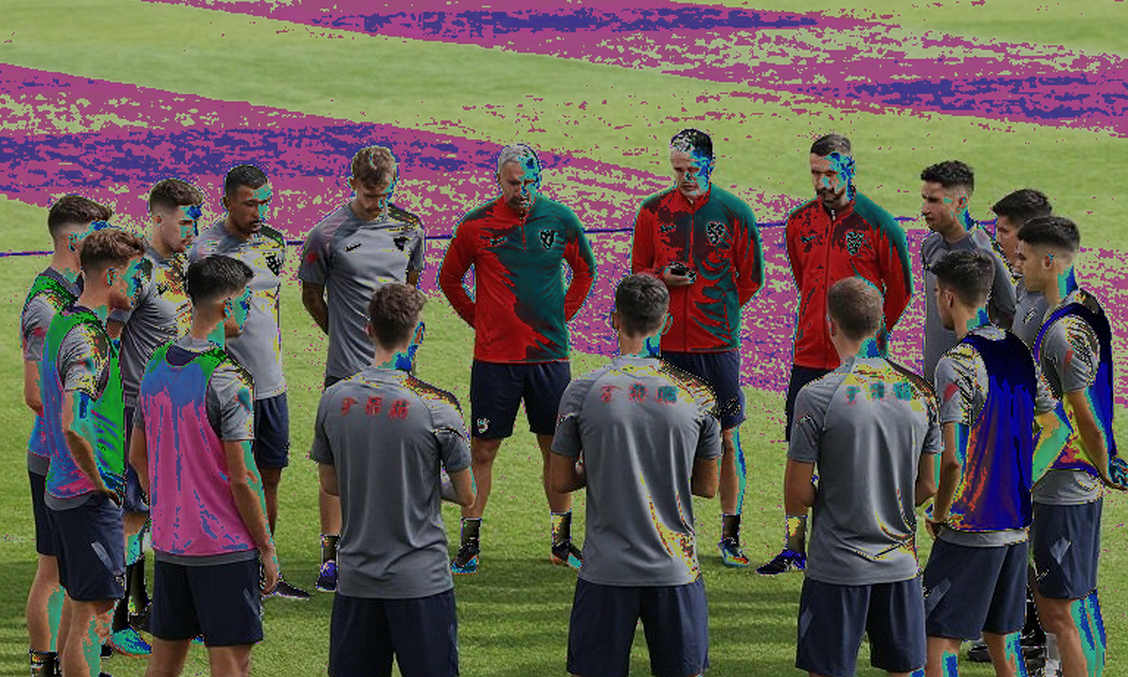
Since VAR entered domestic grounds, each round seems to generate a fresh debate. One round, a penalty is overturned. Another round, a goal is chalked off for an offside measured in centimeters. Another round, the referee is discussed more than the players. Fans in Nha Trang, where I live, call me after such matches, and the recurring question is always: "Was there favoritism?". I do not answer with feelings. I answer by revisiting footage and data, exactly as I did after the night I misread a player's name.
Through three decades on the touchline, I have learned: endurance is not about never falling, but about knowing how to fall in the right posture. Vietnamese football has fallen many times, and each fall taught it something. The question is whether we read that lesson systematically, or let it drift with public opinion.
What troubled me most last season was not any single refereeing decision. It was the whole structure of pressure surrounding the whistle. When a big club steps onto its home pitch, the stands packed, the media filing since morning, a young referee faces no small psychological problem. There is no conspiracy here. Only weight — the weight of the roar, of headlines ready to call him a "point thief" after one decision, of the stadium-operating contract the home club is paying for.
I once sat next to a young referee after a match with VAR. He told me a line I wrote straight into my notebook: the hardest thing is not seeing the foul, but daring to name it while the whole stadium objects. VAR gave him a tool, but not the nerve. Nerve must be trained like a muscle, and it can only be trained when a referee knows he will be protected by process rather than by sentiment.
The asymmetry in how referees are treated is real, and it is rooted in crowd pressure rather than a closed room. For a small club with 2,000 fans, a bad call can pass in silence. For a big club with 20,000, every whistle is a media event. Referees are human, and humans react differently under different pressure. Admitting this does not diminish the profession. It raises its standard by acknowledging its true difficulty.
That is the first angle I want on the table. But stopping at referees only covers a third of the journey. The rest lies in the data stream flowing after every match, a current few fans are aware of.
Every touch, every meter run, every ball contact can become a data point. Analytics firms collect it, process it, and sell it to clubs, journalists, and the betting industry. That is the darkest side effect of digitized sport, and it happens quietly in Vietnam. Data is meant to help us understand the game. But when sold to organizations that care only about betting margins, the same dataset serves a different purpose entirely.
In bigger leagues, analysts have found that real-time positional data can be mined to predict betting patterns. Once that pattern is captured, placing a bet becomes a probability calculation rather than a gamble. Vietnamese football is not yet at that infrastructure level, but the direction is clear. And whenever a match is questioned, my first question is not "who fixed it" but "who collected that data, and gave it to whom."
I do not oppose data. I oppose data collected while people do not understand why they are being collected. Players run, sweat, get injured, recover — and thousands of data points about their bodies are gathered and sold. This is a story about rights and consent, not about technology.
Once, a friend at a sports-data company sent me a table of distance covered in a V.League match. The table was so clean it made you believe you understood the game. But when I placed it beside the footage, it told a very different story. The number said one player ran the most. The footage said that player ran the most because he was chasing the ball, not because he was pressing actively. The data was correct in measurement but poor in meaning. That is the fragile line between analysis and misreading.
The second matter I want to dissect is how Vietnamese football treats its injury cases. Every injury crisis hides a recovery map, if you are patient enough to read it. In 2026, I worked as a data-analysis assistant for the Toyota Nha Trang youth basketball academy, and the story there can illuminate football. The academy's U16 star shooter tore his knee ligament in a session before the national youth championship. The coaching staff wanted to speed up his recovery to make the tournament. I used force-plate data and the recovery curves of 20 similar cases from 2026 to 2026 to argue he needed at least 7 weeks. I wrote a 14-page report citing precedents from the NBA and VBA, proposing a replacement from the youth pipeline.
The academy accepted. He missed the tournament entirely and only began training again in September. The Toyota Nha Trang academy taught me: bones can heal, but broken trust needs a whole season to mend. And notably, if you place that story into football, the impatience occurs far more often.
In football, results pressure often pushes young players back earlier than medical data allows. A national-team player with a sprain can be thrown on at the 70th minute to chase an equalizer, despite recurrence risk. No one stops it. Because in that moment, the result matters more than a recovery-time number. But the price paid later can be an entire career.
What I learned from analysis is to read recovery data by individual context, not by a universal formula. Every player has a different injury history, different loading levels, even different psychology. A 24-year-old with a strong physical base recovers faster than a 32-year-old who has been sidelined by muscle pain four times. If you apply a single timeline chart to both, you are guessing, not analyzing.
Ultimately, in basketball, as in a pandemic, the only certainty is the breathing of endurance. I have seen an entire season reversed by injuries that should have been managed in advance. And I believe the same awaits Vietnamese football in a long annual season with a congested calendar.
This brings us to the third matter: preseason friendly tours. On paper, they prepare fitness and tactics before the season kicks off. In reality, many tours have become circuses. Clubs fly for dozens of hours, play three or four matches in ten days, travel between distant cities, meet fans, greet sponsors, and play before half-empty stands. Preseason fitness is exploited for commerce.
I call it the exploitation of fitness under the guise of preparation. A player returning from such a tour is not in better shape — he is more worn. He has slept more on planes than in beds, run on three different turf surfaces, and endured jet-lag disruption without a proper adaptation window. Two weeks later, when the season kicks off, muscle injuries appear, and no one traces the cause because all eyes are on the next match.
There is another way to see this, and I want to save it for the counter-intuitive section. People often believe more data leads to better decisions. But in a heavily commercialized football environment, the opposite can hold: too much raw data without context creates an illusion of control. A coach may read a load-metric sheet and think he is managing safely, while in fact those metrics are recorded on a sample too small to conclude from.
When a team loses three straight while dominating possession, people blame poor finishing. But look closely, and the problem may lie in the recovery position after losing the ball, not in finishing. Possession tells one story, distance covered another, and success in duels a third. No single metric is enough. The core insight is this: data only has value when the reader knows what question they need answered; otherwise it is noise measured with perfect precision.
That is why I cross-check every number against footage before making a claim. And why I never enter a podcast recording without a shirt-number-to-position roster check. That process is not glamorous, but it has saved me from more mistakes than any innate talent.
In 2026, when all basketball and football leagues were postponed indefinitely by the pandemic, I hosted the Data Perspective podcast with around 300 listeners per episode. In the first two episodes after lockdown, listenership dropped 40%. Many colleagues switched to backstage scandals or emotional predictions. I kept the old structure: analyzing the zone-defense efficiency of VBA teams from the 2026-2026 season, broadcasting steadily every Tuesday and Friday. The 2026 pandemic did not create a new champion, it only filtered out those who were already champions. By June, a listener working as an assistant national-team coach wrote to praise the accuracy, and through that I was invited to advise the coaching staff on data over Zoom.
The lesson from that period applies directly to Vietnamese football today. When a season drags and is disrupted, people are tempted by sensational stories. But real value lies in durable, repeated analytical series, so that when the final result arrives, readers can trace back and verify.
I still keep the notebook of my professional errors. The first page is the night I misread a player's name in 2026. The second page is the week I nearly drew a wrong conclusion by trusting an unverified statistic. The best sports storyteller is the one who knows he can be wrong, and says so before the audience notices. I learned this at no small price, and I have no intention of paying it twice.
So what will shape the rest of the season? The biggest variable is not in the table. It is whether clubs build a data-verification process before making big decisions. A team can win three matches on inspiration, but cannot win a title on inspiration across thirty rounds. And on that long journey, what keeps a team standing is not a tactical trend, but caution repeated daily. Vietnamese football stands before the chance to do that seriously, if people are willing to reread their own numbers and footage.
As for me, every Tuesday and Friday night, I still sit before the microphone, still check the roster by shirt number, still place the footage beside the data sheet. Not because I fear being wrong. But because I know that once I am, sport will not grant me a second chance to explain.